Key Takeaways
- Industrial wastewater problems require solutions tailored to the actual waste stream, site conditions, processing target, and disposal plan.
- Sandling Industrial Services can support temporary and ongoing needs involving dewatering, sludge handling, filtration, dredging, equipment rental, repair, and maintenance.
- Mobile belt presses, plate-and-frame presses, dredges, pumps, and related support equipment can help facilities manage solids and regain capacity.
- Facilities can improve project planning by including flow data, solids information, laboratory results, site details, and target outcomes in their requests.
When an industrial wastewater system cannot keep up with incoming flow, excess sludge, sediment, or changing production demands, the best response is not simply to add a machine. The facility needs to identify the source of the bottleneck, define the desired result, and select equipment that is suited to the waste stream and operating conditions. Sandling Industrial Services provides industrial wastewater treatment support for customers facing solids management, dewatering, filtration, and temporary capacity challenges.
A well-planned response may involve rental equipment, field support, equipment repair, maintenance, or a complete mechanical dewatering approach. The right path depends on whether the facility is dealing with a short-term emergency, a planned shutdown, pond sediment, inadequate sludge-processing capacity, or a long-term operational constraint.
What Should a Facility Do When Its Wastewater System Cannot Keep Up?
Start by defining the operational problem in specific terms. A wastewater treatment request should explain whether the issue is rising sludge volume, poor cake dryness, excessive hauling, limited press capacity, equipment downtime, reduced lagoon volume, or an inability to process peak flows. Clear information helps Sandling Industrial Services evaluate whether the project needs dewatering equipment, filtration, dredging, pumping, repair support, or a combination of services.
Facilities should also identify their practical objective. For some projects, the goal is to reduce liquid content so that sludge is easier to transport. For others, it may be keeping production online while a permanent press is repaired or removing accumulated sediment from a basin. A solution should be designed around the operating goal, not around a generic equipment label.
Why Does an Industrial Wastewater Treatment Request Need Site-Specific Planning?
Wastewater and sludge are not uniform materials. Even facilities within the same industry can have different solids concentrations, particle characteristics, chemical-conditioning needs, contaminants, and discharge or disposal restrictions. Those differences affect how the material moves, filters, compresses, and dewaters.
Waste Stream Factors That Matter
- Average and peak liquid flow rates.
- Total suspended solids and starting sludge concentration.
- Sludge compressibility, particle size, and consistency.
- Polymer or chemical-conditioning requirements.
- Target cake dryness and filtrate quality.
- Disposal route, such as landfill, composting, drying, incineration, or another approved option.
- Available power, water, access, staffing, footprint, and operating hours.
How Does Sandling Industrial Services Evaluate a Treatment Approach?
A productive request begins with information that allows the project team to match equipment to the application. Facilities can prepare for that conversation by following a straightforward process:
- Define the immediate need. Explain whether the request involves added capacity, emergency backup, solids reduction, lagoon cleaning, filtration, repair, or maintenance.
- Describe the waste stream. Share available laboratory results, sludge type, solids concentration, flow rate, and contaminants of concern.
- Set a measurable goal. Identify whether the priority is lower hauling volume, improved cake handling, faster processing, restored basin capacity, or continued operation during repairs.
- Review site conditions. Confirm equipment access, electrical availability, water supply, footprint, traffic limits, and staffing requirements.
- Match equipment and support. Consider belt presses, plate-and-frame presses, filtration equipment, pumps, dredges, and related field services.
- Plan for operation. Establish expectations for setup, monitoring, maintenance, repairs, safety practices, and demobilization.
Which Equipment Can Support Industrial Wastewater Projects?
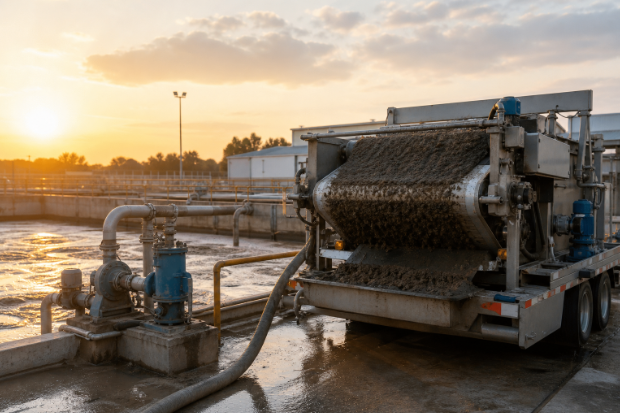
Sandling Industrial Services offers equipment options that address distinct wastewater and solids-management needs. A mobile belt filter press can be a practical option when sludge contains too much liquid and requires mechanical dewatering. A larger 2-meter belt press may suit projects requiring additional throughput. Plate-and-frame filter presses are well-suited to applications requiring pressure filtration and the separation of concentrated solids.
For ponds, basins, lagoons, pits, canals, and similar water-holding areas, mini remote dredges can help remove silt, sand, mud, and accumulated sludge. Workboat services and accessories may also support shallow-water maintenance, skimming, dredging, and debris-management work.
Mobile 1.7-meter belt press systems may include more than the press itself. Depending on the configuration, a trailer-mounted unit can include a conveyor, controls, polymer equipment, a sludge feed pump, a belt wash pump, a filtrate pump, lighting, walkways, handrails, and access stairs. This integrated approach can simplify deployment at facilities that need temporary processing capacity.
When Is Equipment Rental the Right Choice?
Rental can be especially useful when the need is temporary, variable, or urgent. It may help a facility avoid delaying a project while evaluating a permanent capital purchase.
- Choose rental for emergency response, temporary production increases, seasonal demand, construction work, remediation projects, or backup capacity during permanent-equipment repairs.
- Consider ownership when demand is stable, long-term, and predictable enough to justify a permanently installed system.
- Use repair and maintenance support when existing equipment remains appropriate but needs restoration, troubleshooting, or preventive service.
How Can Dewatering Improve Sludge Handling?
Mechanical dewatering separates a portion of the liquid from the sludge, creating a more manageable solids fraction. Lower liquid content can make the material easier to handle, transport, and prepare for approved disposal or beneficial-use routes. It may also reduce the logistical burden of hauling large volumes of water along with solids.
Actual results vary. Cake dryness, throughput, filtrate quality, and polymer demand depend on sludge characteristics, feed consistency, equipment settings, operator practices, and project targets.
What Information Should Be Included in a Request?
- Facility location, desired start date, and expected project duration.
- Industry type and wastewater source.
- Average and peak flow information.
- Solids concentration, sludge characteristics, and available laboratory analysis.
- Existing equipment, current limitations, and maintenance status.
- Target cake condition, filtrate objective, and disposal requirements.
- Available power, process water, access routes, space, and staffing.
- Whether the need is for rental, repair, maintenance, operation, or full dewatering support.
Contact Sandling Industrial Services for a Practical Treatment Plan
Sandling Industrial Services supports industrial facilities, contractors, and municipalities with mechanical dewatering, filtration, sludge handling, sediment removal, rental equipment, repair, and maintenance services. Contact the company through its website to describe the wastewater challenge, share available operating data, and discuss equipment fit, setup requirements, project constraints, and performance goals.
Conclusion
Effective industrial wastewater management starts with understanding the waste stream, operational goals, and site conditions before selecting equipment. Careful planning and accurate project information support better equipment selection, improved solids handling, and more efficient operations. A practical, application-focused approach helps facilities address both temporary challenges and long-term wastewater management needs.